Who’s Thor-y now?

Today I went to see the Thor movie, which I quite liked, and I wrote this:

They killed another of the savages last night, brought it up deck, lashed it tightly to the mast, and took turns with the captain’s whip until the poor frightened beast bled out. This morning, none of three men would claim the killing blow for himself; they hemmed and they hawed and they refused to set their stories straight, though Mr. Murtha and I questioned them each for the better part of an hour, both together and separately. As for the captain, he would claim only the whip, taking it back from the men with half-hearted admonishments I knew were more for my benefit than for theirs. He does not like me, Captain Androse, and I think that would be the case even without Mr. Murtha’s intimidating bulk constantly at my side or the crew’s natural displeasure at having a dead man sailing with them. The captain is as close to another man of science as I am likely to find aboard his ship, less frightened by superstition or believing of rumor, but I know even he would be just as glad to be rid of me. If he could kill me twice, he no doubt would have done so.

If only he knew how little I wish to be here myself.

And yet I go wherever His Majesty sends me, serving at the pleasure of the crown.

The native boy’s death is a distraction — not worthy of our time, the captain says — and what’s worse I know that he is right. What do I care that the men took a little sport with the heathen, took it all too far, and ended his life? As a slave, he would have fetched little profit, and so it is not the destruction of His Majesty’s property that galls me. Nor is it even the principle of the thing… I am bound, not only by royal decree but by the wards the king’s necromancers carved into my skin, to uphold the laws of the realm, but I am free to choose how I do so. We have better things to do than punish these men for spilling a savage’s blood.

And yet why, then, can I not let this go? Is it as a dead man myself that I take offense?

It was, whadyacallit, a Sunday.

Long weekend

I took Friday off, which was really nice, even if I did nothing more exciting with the day than go to the post office and buy some pants. (I did these separately; the post office has a lousy selection of trousers.) It was nice having the day off, though it did weirdly feel like Saturday, which by extension made today feel like Sunday. And while there are things I like about Sunday — the crossword puzzle, my writing group — there’s a certain kind of melancholy to it that I’m not sure needs to be repeated twice in one week.

But still, in reality it was two Saturdays, so it’s not so bad.

Last night, I watched Brian De Palma’s 1978 movie The Fury, which was…how should I put this? Terrible. It’s like De Palma got done making Carrie the year before and thought, “That psychic stuff was fun, but it wasn’t halfway confusing enough. Maybe we could throw in some really bad comedy, too?” The plot of The Fury is just a mess, and characters disappear for long stretches, connect in ways that either bore or don’t make any sense. It stops short of being a total disaster, but only just, and all of De Palma’s worst excesses and impulses as a director are on screen. Carrie, on the other hand, is also full of visual excess — you may know its most famous images even if you’ve never seen the movie — but it also has terrific performances, particularly from Spacek, and a simple story grounding the whole thing.

This? Not so much.

Though I did note that Andrew Stevens, whose acting in this isn’t very good, was last in Mongolian Death Worm. So, y’know, Sepegal.

Tonight, I watched Oldboy, which was….weird. Very violent, disturbing, visually impressive, and weird. I’d been meaning to watch it for some time, since Spike Lee’s American remake will be coming out soon, but Netflix only has a dubbed version available for streaming.

Other than that, I’ve been watching Scandal, which is ridiculous, but ridiculously addictive. Also, How I Met Your Mother, and I decided to sample the first episodes of Arrow and Haven. The latter is a little too Syfy Channel-y for my liking, and the former could become too CW-y, but so far they’re intriguing. Not as compulsively watchable as Scandal, maybe, but intriguing.

That’s been my weekend, more or less, and I still have an actual Sunday to go.

Ender of days

This afternoon, I went to my writing group and wrote this in the time allotted to us:

“If you’re going to raise a demon,” said Howard, “then you raise a demon. You do it right and by the book. This is no time for half measures.”

Daisy nodded, and mmhmmed, although she wasn’t really listening, and moreover she didn’t care if Howard knew it. This was her show as high priestess; she’d earned that title for whatever it was worth, and she wasn’t prepared to cede her authority to Howard just because he’d spent a few more lonely nights in the council library than anyone else. If the council had been looking to reward bookishness, then they would have given the book to Howard, now wouldn’t they, instead of handing the litany of rites and arcana over to her. Daisy respected his knowledge, and lord knew she’d have to lean on it a little when the time actually came, but for now Howard could take all his talk of half measures and demon raising and shove it up his pompous ass.

“Have we heard back from Cairo yet?” she asked him absently. The dig was a good three hour’s drive over land from the capital, she knew, but by now they should have heard something, anything, even rumor. What was that archaeologist’s name again — not the lead, but the one the council had secreted on to the team three months after their arrival in-country? Was it Winsome? Winstone? Daisy could ask Howard, but god, he would love that, wouldn’t he, her not knowing some key piece of information. And Cairo was critical to the success of the ritual, even more than any garden-variety demon raising that might need to be undertaken stateside, and Howard would have no hesitation reminding her about that over and over. It was just the woman’s name Daisy couldn’t remember — it was definitely something with a W, she was sure of that — but she wasn’t about to admit to any ignorance here and now.

“Nothing,” Howard said, “which as I’m sure you know is unusual. If they’ve run into some kind of difficulty at the tomb — “

“It’s too early for contingency plans,” said Daisy. “And you worry too much. Last we heard, everything was going just peachy.”

“That was before the dreamer awoke,” said Howard. “They’ve been transcribing new prophecy for the better part of an hour.”

“The dreamer,” Daisy snorted. “You old guys put way too much faith into the things that man says. If I smoked a half pound of hashish before bed I’d have some weird visions too. What was that one about all of the women with arms slicked to the elbow with oil and rice and tiny cubes of diced vegetable matter? It’s crazy. Show me a single ’dream’ of his that has led to anything tangible.”

“He found the old one’s tomb,” Howard said.

“That’s debatable,” said Daisy. “It’s a lot more likely the old one’s the one who found him.”

It’s probably not too difficult to figure out one of the writing prompts, shoehorned-in as it is there. (I picked it, so I have no one but myself to blame.)

After that, I went with the group to see Ender’s Game.

Before seeing it, my feelings about the movie were pretty complex, owing mostly to Card’s odious politics and extreme right-wing views. I thought about buying a ticket to a different movie, or boycotting it altogether. Although that would only be symbolic at best — John Scalzi rightly points out it would be hard to monetarily hurt Card at this point with one, or even millions, less ticket sales — there was a certain appeal to it. But I wasn’t really looking to make a symbolic gesture, and I think I can see the movie without it reading as an endorsement of Card’s backward views on homosexuality.

Then people on Twitter started talking about the book itself, and how it was bad, with its own breed of noxious politics. While less of a screed than Card’s more recent political writing, they argued that the book itself was worthy of derision and boycott.

I haven’t read the book since I was about Ender Wiggin’s age myself. I was tempted to try to find my old copy — I think it might be buried in a box in the basement — that temptation came only sometime this morning. (I mean, I did have that extra hour, but it was not to be.) From my memory of the book, though, I think those people are wrong, if only because the terrible things that are done to, and ultimately by, Wiggin in the book are not necessarily presented as a good thing. And — spoiler warning — he spends most of Speaker for the Dead, the sequel, trying to atone for the brutal genocide he’s ultimately (albeit somewhat unwittingly) responsible for in the first book. I’ve read Speaker (and Xenocide) more recently, and Card the man, with his baggage of views and politics, doesn’t really rear its ugly head.

The book’s not perfect, and I think maybe it does deserve a re-read from me at some point to better unpack those imperfections, but I remember liking it a lot, even if I was only about twelve at the time.

So my feelings were complex. A couple of days ago, on Twitter, I wrote: I will/won’t go see Ender’s Game because it doesn’t/does reflect the author’s original intent. Yeah, I think that about covers it.

After seeing the movie…well, it was okay.

Space oddities

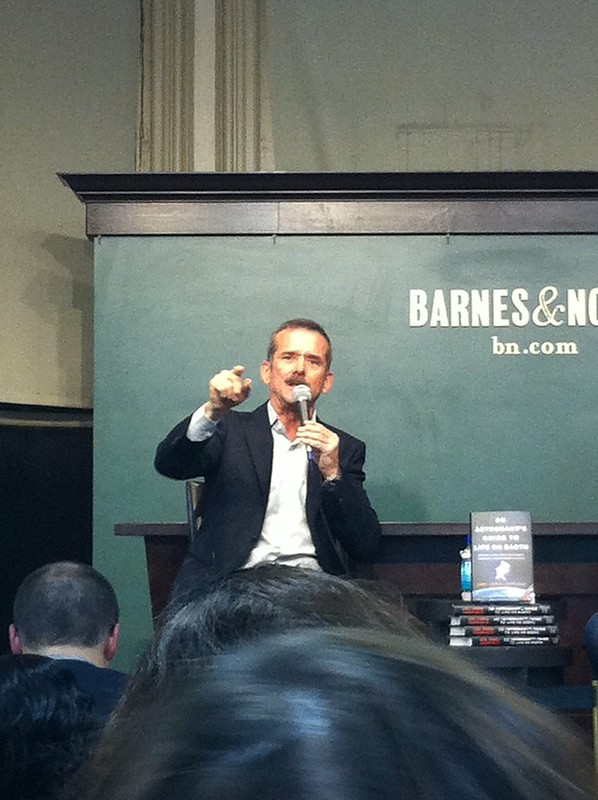
Last night, I met an astronaut.

Well, I didn’t actually meet him, but I attended a talk by Canadian astronaut Chris Hadfield, who you may know from videos like this one, from the International Space Station. He’s been called “perhaps the most social media savvy astronaut ever to leave Earth,” for his YouTube videos and his tweeting from space, and he’s just as funny and interesting in person.

Tonight all I really did was watch Rebecca, which was pretty much exactly what I thought it was going to be, right up until the third act, when it became nothing like I thought it was going to be. I liked it, but I think it was maybe a little more impressive in 1940.

I also finally watched the first episode of the new season of The Walking Dead. I’m cautiously optimistic, if a bit unsettled and disgusted.

Other than that, there’s not a whole lot to report. Somehow, while I wasn’t looking, it turned into November. Already? Well, I guess then it’s time to post my music mix from October.

  1. “Haunted” by Kelly Hogan
  2. “Museum of Flight” by Damien Jurado
  3. “Simple Song” by the Shins
  4. “The Weight” by Aretha Franklin
  5. “Are You Out There” by Dar Williams
  6. “Hand Clapping Song” by the Meters
  7. “Rewrite” by Paul Simon
  8. “Days That We Die” by Loudon Wainwright III
  9. “Kiss the Sky” by Shawn Lee’s Ping Pong Orchestra (feat. Nino Moschella)
  10. “I Always Knew” by the Vaccines
  11. “Until We Get There” by Lucius
  12. “Your Ghost” by Kristin Hersh
  13. “Let’s Roll Just Like We Used To” by Kasabian
  14. “Adios to California” by John Hiatt
  15. “Rap God” by Eminem
  16. “Salvation” by Black Label Motorcycle Club
  17. “Never the Bride” by Linda Thompson (feat. Teddy Thompson)
  18. “The Balcony” by the Rumour Said Fire
  19. “I Think It’s Going to Rain Today” by Nina Simone
  20. “Goodbye” by Turin Brakes
  21. “Now I Am an Arsonist” by Jonathan Coulton (feat. Suzanne Vega)
  22. “Nursery Rhyme of Innocence and Experience” by Natalie Merchant
  23. “Half an Acre” by Hem
  24. “Greem Valley” by Puscifer
  25. “Retrograde” by James Blake
  26. “Rebel Girl” by Bikini Kill
  27. “C’mon Billy” by PJ Harvey
  28. “Little Bird” by the Weepies

Mostly for my own records. I like keeping records of these things for some reason.

The last few days

On Saturday night, I watched The Conjuring. It has its moments — if you’ve seen the original trailer, you’ve seen the best of them — but it also falls into a lot of the same traps as Insidious before it. That’s not surprising, in that it’s by the same director, but while James Wan gets a lot of things right, and he crafts some genuinely well-executed scares, the movie ultimately just grows a little tedious, and it’s bogged down in half-sketched mythology. Explaining a ghost almost always makes it less frightening. Like Insidious, this movie is both very smart and very dumb about what’s scary.

Part of the problem is that it’s framed somewhat as a biopic, of “paranormal investigators” Ed and Lorraine Warren. They’re well cast — I don’t think any movie with Vera Farmiga in it can be totally bad — but as characters they’re a distraction more than anything else. Just once, I want a horror movie that says up front, “The following is based on total bullshit,” rather than, unconvincingly, “based on a real story.*” Not least of all because any story with the Warrens at the center would be immediately suspect even if I believed in ghosts. There’s a throw-away joke at the very end of the movie where Lorraine says, “There’s a case out on Long Island he wants us to check out” — a knowing wink to their most famous case, the one on which they built their reputation, the Amityville Horror house. What the film doesn’t hint at, of course, is how thoroughly that case has been debunked (despite the books and bad movies), and the reputation along with it. If anything, the Warrens are depicted in The Conjuring as saintly and selfless, with evidence so incredibly compelling and freely shared it’s amazing that anyone could possibly not believe what they say is true.

My real problem, though, was it just wasn’t scary.

After that, I spent a few hours capping, probably the closest I’ll come this year to a Halloween party.

On Sunday, I wrote this:

The subject was bound to the chair, had been for the past hour, unmoving and unresponsive. Had it been anyone else, Markov would have assumed the subject was dead, had expired sometime during the last battery of tests, and that the slow arrythmic blip blip blip that monitored its breathing and heart-rate were nothing except echoes, either of his own faulty hearing or of faulty, misreporting machines. But he knew this subject too well, had been warned about its behavior too many times to think this was anything but playing possum. It could control its reflexes, but not perfectly, could slow its pulse and breathing, but not stop them entirely. Markov knew that, if anything, the subject was just biding its time, hoping that he, Markov, would make a mistake, get too close, assume the possum had passed on, and not for the first time he was grateful for the force field that circled the chair and the subject both.

“You can’t trust anything they say,” Andrew had said. “Some of them, they’ve learned our language, adaptive behaviors. They even look human.” This was only a month before one of them had escaped, briefly, from its cell, had taken Andrew and a fellow researcher hostage and, in the final shoot-out, skinned both of the two men alive. That, even more than Andrew’s words of warning, had convinced Markov that simply looking human didn’t make them human; they were beasts, angry and violent and dangerous. Lying still for half an hour certainly didn’t change that.

Sometimes he wondered if death wasn’t too good for these mutants.

But there was so much to learn from their behavior, their anatomy, the strange tricks that nature had played to enable them to live, unassisted, on this backwater planet. It was an impossible jungle out there, deadly in ways that Markov and his team had not even begun to count, and yet they lived, these mutants; they thrived. Once they had been human — even Andrew, even Markov, would have admitted to that. The evidence was too great, the branches of their shared family tree too well laid out, even if the history, the actual events that had split those branches in such different directions, remained elusive and unclear. But that made the work they were doing here more important; it did not make the mutants any less expendable.

The subject began to stir, perhaps accepting, finally, that Markov was not going to lower the force field, that the scientist would offer it no means of escape. Markov smiled and returned to his work.

Then on Monday, I worked, moved a dresser across the room, and wrote this. That’s about it, really.

* My favorite recent example of this is the trailer for Nothing Left to Fear, which claims to be “Inspired by the legend of Stull, Kansas.” As near as I can tell, the movie isn’t actually about any of those urban legends, so the trailer could just as easily have said, “We read about a spooky thing and wrote a movie that’s spooky too.” Actually, I think more movies — non horror movies — should come with disclaimers or title cards that announce their loose basis: “Based on the author’s vague memories of a TV show she used to watch.” “Inspired by a pleasant walk the director took with his dog.”

That said, a friend has tried to convince me that Nothing Left to Fear is actually pretty good. And it has Clancy Brown in it, who we all know can do no wrong.